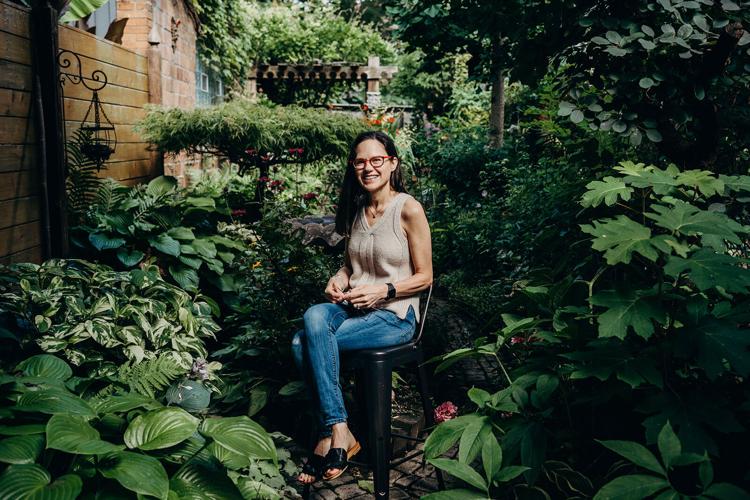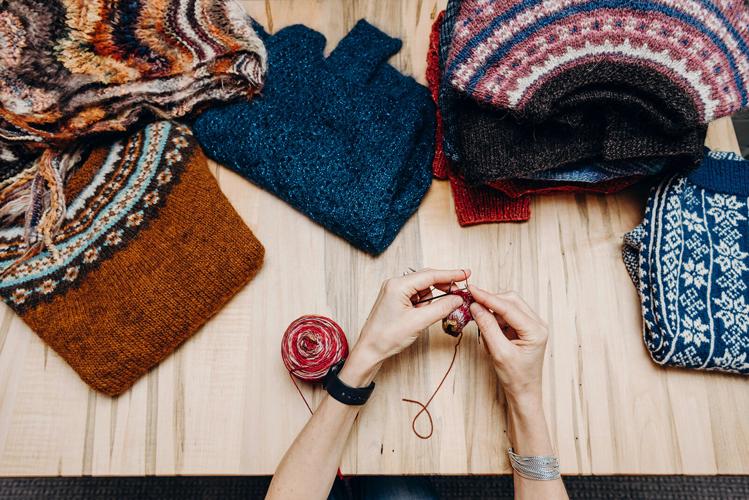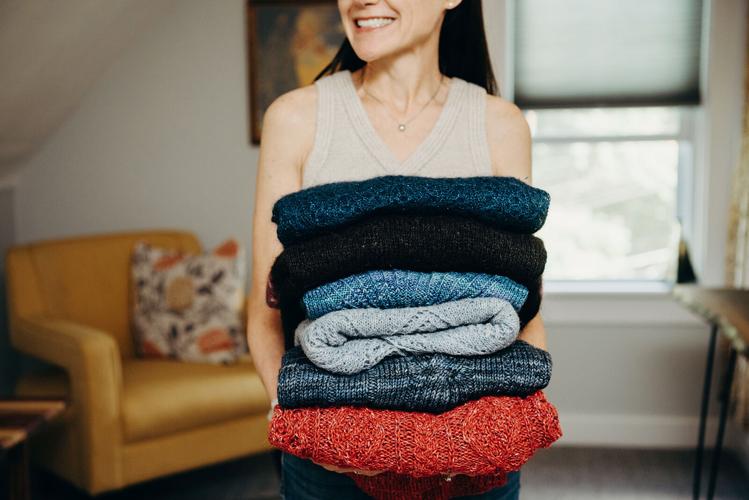
“There are two different kinds of knitters. People who like to move their hands and people who like the finished product,” says Hilary Turco. “I’m in the middle.”
Though Turco—an elite knitter vying for certification in the Master Hand Knitting Program with The Knitting Guild Association—observed this late in our interview, it was immediately clear that I was dealing with a knitter who embodied a rare combination of attributes.
She’s self-taught yet eager to learn. In 2006, Turco picked up the craft while traveling.
“I used to fly a lot for work. So I would be on my own in airports for hours with nothing to do. It was too loud to read. But I needed to keep busy with something,” says Turco. “I taught myself with books, which was very difficult because the illustrations were not the best. But I was determined.”
People are also reading…
She’s resolved yet flexible.

As Turco became more skilled in knitting, she couldn’t help but wonder if she was doing it properly and the absolute best that she could.
“Knitting is a skill that people learn from their mothers and grandmothers, and it’s all different,” she says. “Not everyone has the same methodology.”
Turco turned to The Knitting Guild Association (TKGA) to be her North Star. She started with the Basics, Basics, Basics course and if she wasn’t doing something the “correct” way, she would simply adjust without any ego.
Next, she set her sights on the Master Hand Knitting Program. The certification process is lengthy and rigorous. Swatches were knit, reports written, references documented, questions answered and projects completed.
“There are three levels and each builds on the previous level,” she notes. “A knitter is expected to research specific techniques, practice them and submit examples showing they have mastered them with clear and concise instructions for someone else to follow.”

Turco smiles as she explains the specific requirements because she’s ambitious yet completely fulfilled. The demands motivate instead of discourage her.
Here is a general breakdown of each level:
- Level 1: Basic techniques including gauge, blocking and small pattern work. One project: mitten. It takes 12 months to complete.
- Level 2: Finer details including finishing and seaming techniques. Three projects: wristlet, argyle sock and vest involving Fair Isle and Intarsia techniques. It takes 18 months to complete.
- Level 3: Design and creativity focused with advanced stitch work as well as writing and creating your own patterns. Two projects: one hat and one sweater (one in traditional Aran style and one in Fair Isle style, both self-designed). It takes 24 months to complete.
After each level, the knitter sends the materials to a review team for evaluation. Critiques may be sent back before a given level can be passed. Turco is currently on Level 3, which will be completed in 2025. If that seems far off, Turco doesn’t seem to mind. She’s enjoying the journey.
“At this point, I’m not entirely sure where it will take me. The program is extensive, but there will always be more to learn,” she says. “I’ll have a good foundation to be able to teach, write or design, but I may decide that I want to knit just because I enjoy it. Whatever the case, I’ll be happy knowing that I’ve become a more knowledgeable knitter.”
Now that’s totally Hilary Turco.