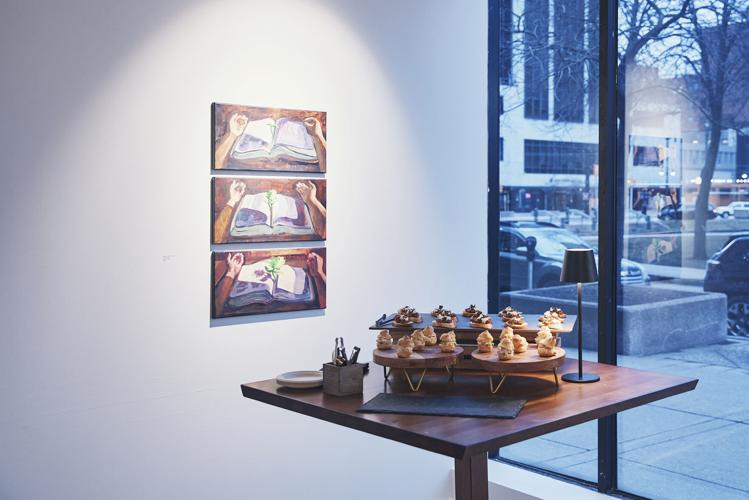

It’s not novel for an art gallery to serve finger foods while guests scan the artwork and mingle. At a gallery opening, you can usually expect to snack on a slice of cheddar cheese and an olive, then wash it down with a gulp of pinot grigio served in a clear, plastic cup.
But imagine if food was an equally important part of an art gallery experience, where thematic hors d’oeuvres complement the paintings that fill a gallery’s white walls, giving guests something more accessible to discuss while they formulate their thoughts about the art.
For a chef father and his artist son, food and art make a natural pairing.
Chef Stephen Forman and his son, Stephen Forman Jr. (who goes by the artist name Paulie!), team up to host events exploring important issues within the Black community using their strengths: cooking and painting. They call their venture “Serving the Solution.”
People are also reading…
On a snowy evening in February, Paulie! and Forman gathered guests at Beebe’s at the Gallery to explain the relationship between their paintings and hors d’oeuvres. Forman worked with his son to develop several stations of appetizers that reflected elements of Paulie!’s artwork.
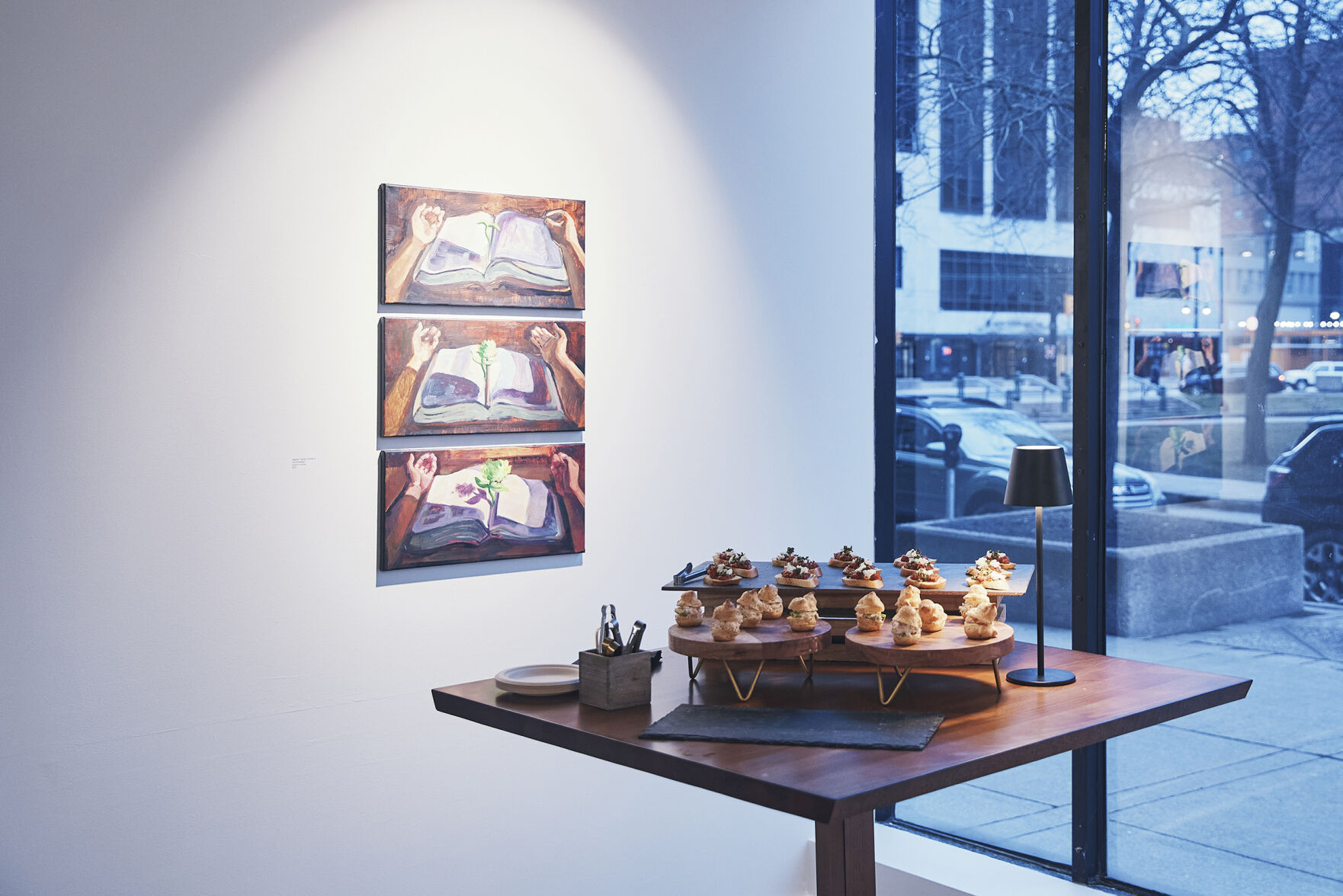
A triptych by Paulie! paired with accompanying seed-infused appetizers conceptualized by his father.
For example, seed-infused canapes sat on a table in front of a triptych painted by Paulie! depicting a plant blooming from the pages of a book. Forman conceptualized each appetizer around different seeds—pumpkin seeds, poppy seeds and chia seeds—to represent seeds of knowledge.
“Knowledge has always been looked at as a seed, right? You drop a seed of knowledge and then from there it grows,” Chef Forman told the guests.
So far, the Formans have held two “Serving the Solution” events. Starting this fall, they plan to hold them on a quarterly basis at Beebe’s, located at 403 Main St. in the historic Brisbane Building downtown.
“Food is such a social thing,” said Jessica Mjoen, an attendee at February’s event. “At the grazing table, you’re bumping into people and saying ‘Hi.’ You’re not just staring at artwork.”
From doodling in sketchbooks to drawing caricatures of people on the Canalside boardwalk, Paulie! has thrown himself at becoming an artist since he was a child.
“My parents would push me to do whatever I wanted to do,” Paulie! says. “It was always art.”
His artwork—vibrant, imaginative and narrative—can tell a story in a white-walled gallery from start to finish on its own. But he’s found a less conventional (and a lot more fun) way to share his work by teaming up with his father. Chef Forman is the regional executive chef for Delaware North and the chef/owner of food consultant company Thyme-N-Honey.
February’s event explored the need for more greenery within Buffalo’s predominantly Black East Side, particularly around the Kensington Expressway/Route 33.
The paintings told a story of past, present and future. While his work is optimistic for a healthier, more prosperous and greener future for Black people in Buffalo, Paulie! doesn’t let the people who segregated the community off the hook. His work questions the government’s usage of resources, brings light to its historic refusal to invest in Black communities and illustrates the long-lasting effects of racist housing policies.
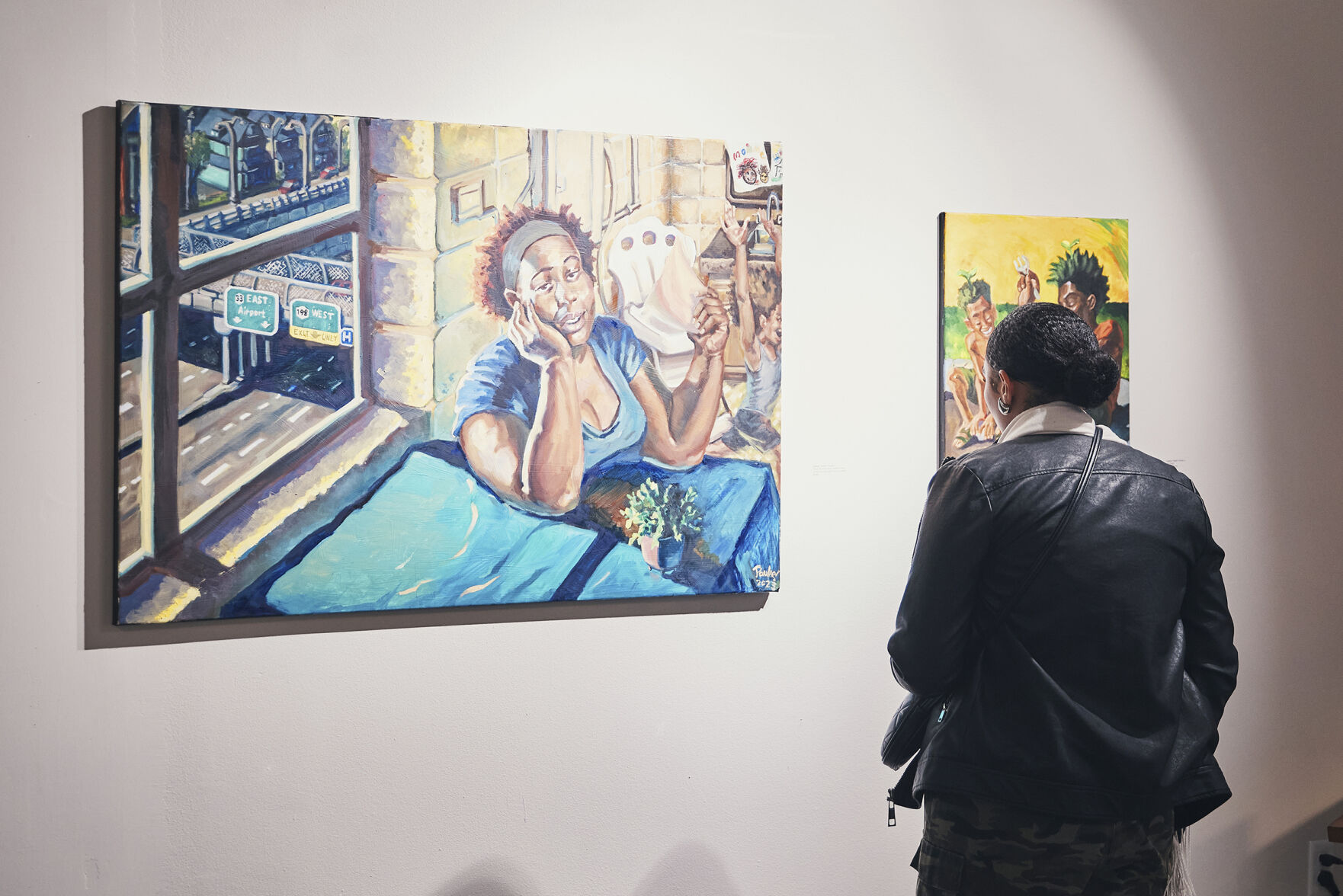
“Where’s the money going?: Sweltering Home,” by Paulie!
In one piece called, “Where’s the money going?: Sweltering Home,” Paulie! painted a Black mother sitting in her kitchen, which overlooks Route 33, cooling herself off with a hand fan. He was inspired by a 2020 New York Times article about how redlining robbed Black neighborhoods of green spaces and their cooling effects in Richmond, Va.
It’s a story Buffalo knows all too well.
Paulie! grew up near the 33, around East Utica and Purdy streets. He remembers hearing stories from his uncles and grandparents about how beautiful and verdant the Olmsted-designed Humboldt Parkway was before it was ripped apart to construct a highway.
But Paulie! has hope for a greener Buffalo. His optimism is fueled by the state’s billion-dollar commitment to reconstruct part of Humboldt Parkway and bury the highway in an underground tunnel.
“There is hope,” Paulie! says. “There is something to look forward to.”
Snickerdoodles, jellybeans and chocolate pudding cups accompanied the last couple of paintings, including the final piece in the series, “Nu-Humboldt.” In it, Paulie! paints an aerial view of what he imagines Humboldt Parkway could look like again one day: lush with bushy, green trees.
“It’s about seeing Black bodies in a greater future,” Paulie! says. “Whether that’s health, wealth or foliage.”