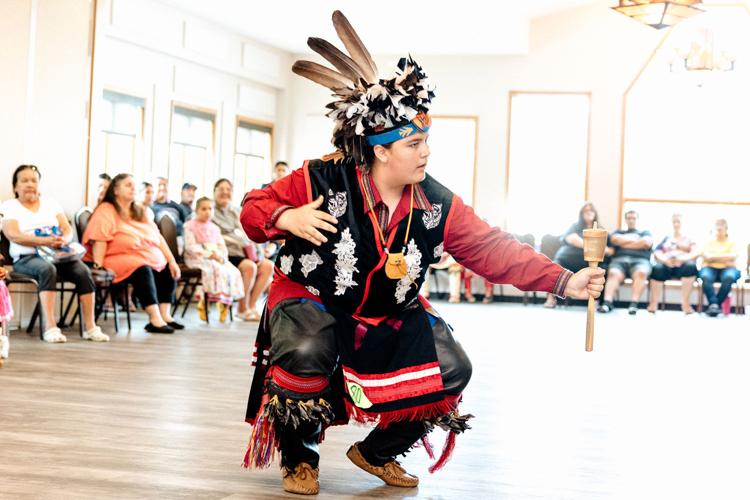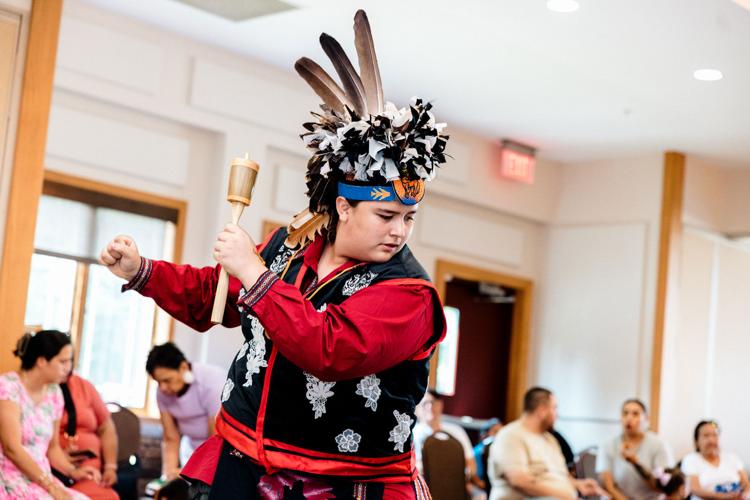
A sturdy teenage boy in a red shirt and black pants appears to be in his own world on the dance floor, his long black pony tail swaying and jumping with every move.
In stark contrast to the chaotic moves displayed in dimly lit high school gymnasiums by most tenth graders, every one of his fast-paced foot placements and head tilts are precise. These are the sacred steps of the Haudenosaunee smoke dance. The dancer is Hunter Bradley, a young man summoning the soft moccasin-ed steps of his ancestors on the ground they once tread.

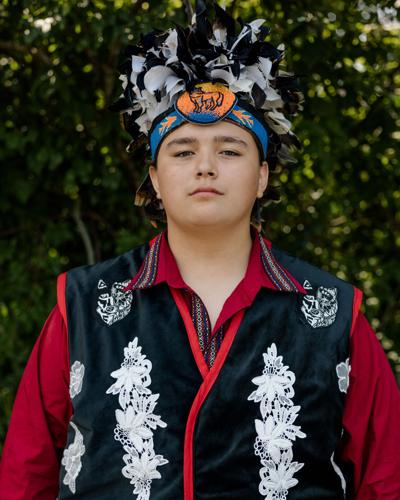
Hunter Bradley performs the Haudenosaunee smoke dance, a sacred tradition that he wants to carry on. “I don’t want it to die with me,” he says. “It’s a way to honor and remember all the loss our people experienced.”
The smoke dance is an adapted war performance choreographed to exhibit men’s skill, speed and stamina. The name comes from the dancers’ quick spinning in small circles reminiscent of curling smoke. At 14 years old, Hunter is one of the younger boys in his smoke dance competition bracket, but his composure tells of experience beyond his years.
People are also reading…
In the audience at every competition is Hunter’s grandmother, Vivian Bradley, a Haudenosaunee elder who does a lot more than just sit on the sidelines. When Hunter showed interest in learning smoke dance, she provided endless encouragement and hand-made several key components of his costume. At 80, Vivian’s practiced hands turn out extraordinarily detailed traditional beadwork: neat rows of tiny glass seed beads sewn into figures and patterns with cultural significance and colorful beauty.

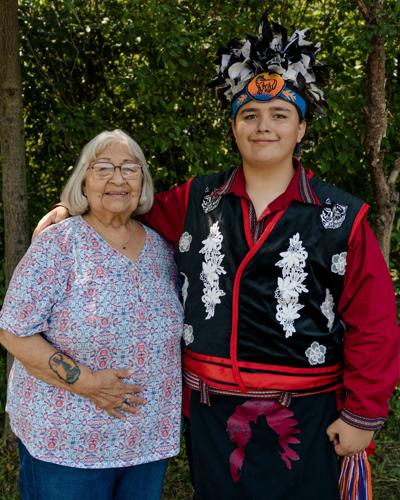
Haudenosaunee elder Vivian Bradley and her grandson, Hunter. Vivian also holds the position of Elder Program Director at Native American Community Services (NACS) on Buffalo’s West Side.
She not only made Hunter’s leather dance moccasins, but her skills are also sought after for other Seneca Nation ceremonial occasions.
Every spring, graduating Native seniors who wish to cross the stage in full tribal regalia ask Vivian to decorate their mortarboards and ceremonial sashes with beadwork. A bride recently commissioned two pairs of hand-sewn leather moccasins for her wedding—hers adorned with a beaded turtle, his topped with a snipe, symbols of their respective clans. Even Vivian’s walking cane is a work-in-beaded-progress, with several rows of tiny glass beads wrapping its wooden shaft, the thread and needle tucked underneath to continue in idle times.

At 80, Vivian’s practiced hands turn out extraordinarily detailed traditional beadwork: neat rows of tiny glass seed beads sewn into figures a…
Vivian’s skill in these traditional crafts wasn’t passed down from past generations as one might expect. Residential schools—U.S. government-funded and church-led boarding schools that forcibly removed First Nations children from their families and punished all forms of indigenous expression—interrupted the inheritance of cultural knowledge including language, craft, survival, food, stories and customs. Vivian’s mother was a residential school survivor, and her experiences there instilled a strong will to protect her daughters.
“She didn’t want us to learn the traditional ways,” she explains. “She was afraid someone would stop us and hurt us.”
Instead, Vivian learned beadwork with her sisters, who practiced with other women from the Iroquois Confederacy she met at The Nya:Weh Indian Village cabins at the Erie County Fair nearly 40 years ago. Many in Vivian’s generation have spent decades reaching back to grasp and repair those severed ties by learning, practicing and re-installing customs into ways of life. It’s work that makes her proud—and determined.
“These traditions were here first,” says Vivian. “They didn’t disappear even though many wanted them to. This is us, and there’s nothing to be ashamed of. We understand what the ancestors went through, and they are here with us.”
Reconnecting with tribal ways is a focus of Vivian’s work as Elder Program Director at Native American Community Services (NACS) on Buffalo’s West side. The program supports older members with social activities, support resources and dedicated time to practice and share traditional storytelling, crafts and language. The elders also serve as teachers for the center’s youth.
“This work brings me to the environment of my heritage that I didn’t grow up with,” says Vivian of her 16 years of service at NACS.

Like Vivian, many Haudenosaunee elders are placing a lot of hope in younger generations to carry this knowledge forward. If she can’t make it to one of Hunter’s smoke dance competitions, other tribal elders proudly fill in for her and capture performance videos so Vivian can see (and post to Facebook).
Hunter and Vivian work together to continuously improve his elaborate traditional smoke dance costume. An aunt gave him his gustoweh, a feathered headdress with three upright feathers signifying his tribe. He’s learned how to make arm bands, bags and deer-hoof bells himself by watching videos online—the same way he learned how to dance two years ago. Because dancers are scored partially on how closely their steps match the music, Hunter recently started learning how to sing the songs to add precision to his performance.
During the busy summer competition season with events nearly every weekend from June through November, Hunter has met new friends he keeps in touch with between dances. Although he says most of his local tribal friends and siblings don’t care about dancing, Hunter did encourage his friend Michael to join him. Vivian helped make his outfit, too, and won a ribbon for the vest she made.

Along with new friends and appreciation for old ways, Hunter says the hard work he puts into smoke dancing has paid off outside of Native American circles. He plans to put his fitness and fast feet to work on the lacrosse field for Buffalo Public Schools this spring. Competing against older dancers in front of exacting judges and large crowds has also changed the way he carries himself in school and the community.
“Dancing gives me more confidence,” he explains. “My family and friends are proud of me.”

Hunter continues to study, practice and review footage to find areas to improve his dance presentation like football players revisit gameday clips for performance clues. It’s hard work and dedication, and he loves every minute of it.
But it’s far more than just fun. Hunter sees it as his duty to make his elders proud, and to preserve the traditional ways passed down to him by his grandmother and others.
“I don’t want it to die with me,” he says with conviction. “It’s a way to honor and remember all the loss our people experienced.”