Forest Lawn’s very own arborist Andy Howard sits down with CEO Julie Snyder to talk all things trees and groundskeeping at Forest Lawn Cemetery. From becoming a level II Arboretum to nerding out on nature facts, Andy gives you a peek behind the leaves at how we maintain one of Buffalo’s most historic cemeteries.
Spring is finally in the air in Western New York, and there’s no better place to take it all in than the City of Buffalo. Well, one spot in Buffalo in particular: Forest Lawn Cemetery in the north part of the city, adjacent to Delaware Park.
A 269-acre historic cemetery that’s the final resting place for more than 165,000 people, including U.S. President Millard Fillmore, Forest Lawn is still an active burial site and also a certified Level II Arboretum. There are roughly 4,100 trees and 270 species of trees on site.
Only 900 arboretums are accredited globally, and just 242 have earned a Level II designation. Andy Howard, who has worked at Forest Lawn for 18 years, recently was certified as an arborist and works with the rest of the grounds crew to thoughtfully build and maintain the cemetery’s vast inventory of trees. He says the cemetery acting as a green space has always been core to its mission.
“The history, the topography—a lot went into it,” he says. “The cemetery was placed outside of the city as a refuge, as a place where people could go and relax; so that was part of the plan right from the start. That makes my job easier, because they thought of this 175 years ago.”
Forest Lawn has a goal of restoring the tree canopy to 6,000 total trees by its 200th anniversary, which is 24 years away. The cemetery’s trees have been battered in the past two decades due to Dutch Elm Disease, which killed 1,000 American Elm trees, and the 2006 ice storm, which destroyed 800-900 more. Over the last two years, Andy and his team have planted hundreds of trees.
“Many people have said that that when they come to Forest Lawn and come in and go down the hill very near Mirror Lake, surrounded by the trees and the landscape, you would not know you’re in the middle of a city,” says Julie Snyder, CEO of Forest Lawn Cemetery Group. “And I think that’s really one of the highest compliments to [Andy] and the grounds team and the intentional way that we’ve maintained that landscape.”
Julie said the cost to plant a tree is around $2,000, including sourcing the diverse species needed, purchasing the actual tree and then planting, staking and protecting it through the first few years. Removing trees that have fallen or come to the end of their life cycles can run thousands more. Though it’s a costly pursuit, she has no doubt of its value.
“Maintaining a landscape in this very urban setting is not just a benefit to our permanent residents who lie in rest, their families, all of our lot holders—I will say that the community greatly benefits from the arboretum at Forest Lawn,” Julie says.
“One of my favorite things to do in the cemetery is just watch people,” Andy agrees. “They come in, they walk, they ride their bikes, they visit their loved ones—but they also just enjoy the area and the nature and the landscape.”
Charitable donations designated for the arboretum have helped purchase TreeKeeper software available under the “Plan Your Visit” tab on the Forest Lawn website, allowing the cemetery to maintain a live inventory of the trees onsite and visitors to look up every individual tree and have a resource to identify them.
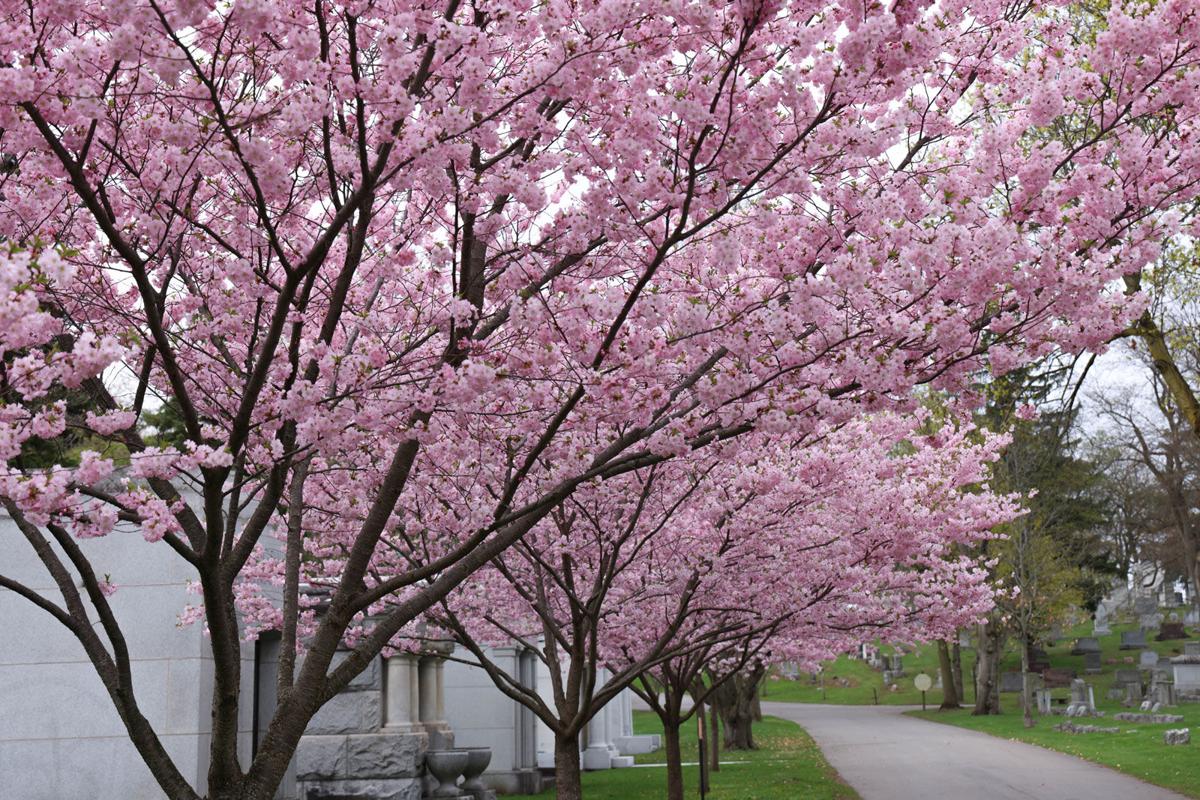
From the white-flowering Yoshino cherry trees around Mirror Lake to a thriving grove of bald cypress trees that date back to the Pan-American Exposition in 1901, to recently planted future stunners like a flowering katsura, Franklin tree and red flowering dogwoods, there’s always something to see at Forest Lawn—and, thanks to the work of Andy and his team, there always will be.