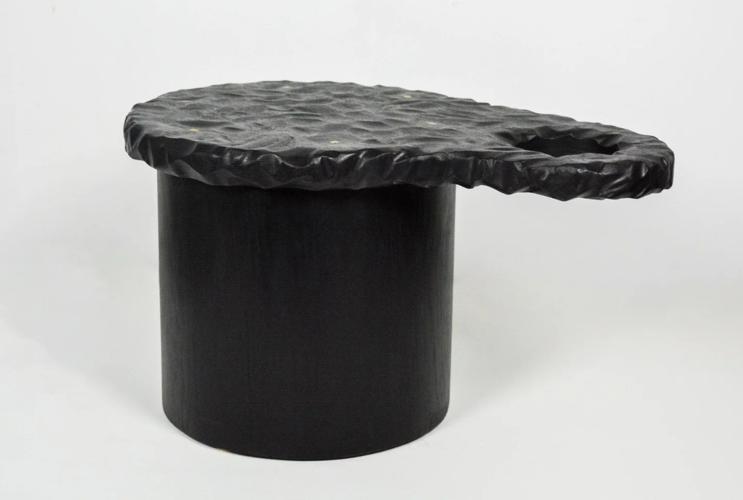
The table is shaped like a soft apostrophe with a circular hole carved through the tear-tip end. The top is smooth and undulating like the dark, inky surface of a calm lake at midnight, inlaid brass pins creating a circular constellation of contrasting points reflecting light. It extends a sturdy invitation to come closer, take in the details, run a hand over its rounded edges like a worry stone meant to set a drink on.

Lumpy Table: "A hand-carved side table crafted from solid ash, this sculptural piece features a 'perfectly lumpy but smooth' tabletop, highlighted by inlaid brass pins and finished in India ink with a water-based protective coat. The Lumpy Table merges playful organic form with functional design—reflecting sustainable, handcrafted craftsmanship and contemporary Indigenous furniture design."
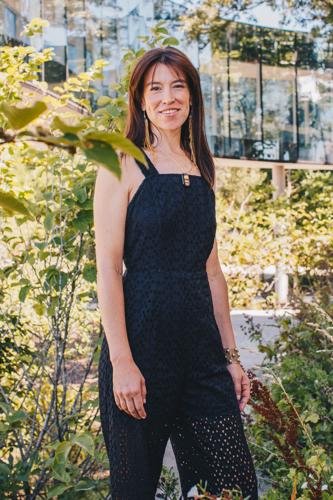
It’s simply called the “Lumpy Table,” and it’s the work of Ashley J. MacDonald, an Indigenous sculptural furniture designer whose work both tells and invites stories.
“Furniture is sculpture we live and interact with all the time,” she explains. “It’s an installation. As you curate pieces in your home, you’re telling the story of you and your life. They become more personal as you use them. When finishes rub off, a surface gets scratched and we remember how it happened—there’s a certain innate memory in that.”
People are also reading…
Ashley’s craftsmanship tells tales of its own. It reflects a meandering career path that wound through unexpected troves of inspiration and skill. Construction work in Calgary taught her to work with blueprints and layouts. Five years as a freelance residential plasterer lent a taste of self-employment. An honors degree in furniture design and an advanced diploma in creative problem solving from Sheridan College sparked a passion she’d come back to later. Six years as a film and theater prop artist challenged her to use her imagination and a cacophony of materials to create structurally sound pieces that support a narrative.
It all came together in 2023 when, feeling unsatisfied with her work and purpose, Ashley started to pour her talents into designing furniture. She launched her WABUZ collection in Buffalo in spring 2024, opened a studio in Niagara Falls, N.Y. later that year and now dedicates all her skill and energy to her craft.
In many ways, Ashley is an artist whose influences exist in dichotomies. Her creative mind dreams up a sculptural chair that’s a wonder to look at, but her trade skills construct it as a practical, sturdy seat.
She grew up in Ontario but spent nearly every weekend in Buffalo visiting family, experiencing a Queen City childhood and making memories visiting Ted’s Hot Dogs, catching shows at Shea’s Performing Arts Center and cheering on the Bills. She chose to host her studio’s launch party in Buffalo, a place where the arts and Indigenous communities have embraced her, and the industrial grit and spirit of tenacity has influenced a lifetime of ideas.

Ashley’s furniture aesthetic also reflects her dual Cayugan and Austrian heritage.
“I didn’t grow up on a reservation or have experiences that relate to traditional craft, so making a totem pole or moccasin would be untrue,” she explains. “I am of mixed heritage, and I grew up in an urban environment. My work bridges the Indigenous and contemporary and explores what it means to be both of these. In some ways, the European is the business side and the Seneca is the creative side.”
Though worlds apart in many ways, she does find similarities in the aesthetic influences of her ancestors. Austrian folk art, for instance, features repeating patterns, color schemes and botanical motifs that are similar to Indigenous artistry.
Ashley offers her work for sale in three different categories, each curated with a different kind of shopper in mind. Collectors can peruse ready-made furniture and decorative pieces on her online shop, which features one-off flights of fancy, experimental and too-intricate-to-replicate works. Custom designs are available for buyers who have something specific in mind.
The third offering is something Ashley is currently working to expand: contract furniture in contemporary Indigenous designs, which would allow her to make multiples of one type of piece for use in a small hotel or housing development. The goal is to scale efficiently without losing her handcrafted, sculptural touch, and to be able to bring something special to a place like a hospital.

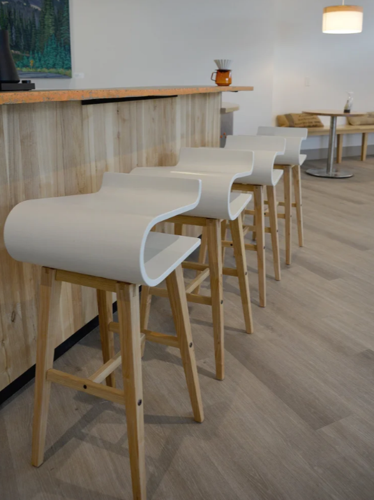
Float Barstools: "Sculptural seating pieces crafted using the same method as pressing a skateboard deck. Multiple layers of veneer are laminated and molded to create intense curves that not only provide aesthetic appeal but also structural resilience. This technique, inspired by skateboard manufacturing, ensures the stools can withstand significant weight while offering a bouncy give for enhanced comfort. Solid ash base."
“I’ve been asked several times if I can handle a big order of multiples, say 40 or 50 of something, to execute an architectural plan within a whole building,” she explains. “There are efficiencies in doing that, but as artists, we don’t often think that way. I’d love to get big enough to need investors.”
True to her tendency to have one foot in two different places at once, while Ashley attempts to scale operations inside her studio, she’s also on the road offering site-specific installations at art festivals and street fairs throughout Western New York.
For Rhythm & Roots in Lewiston, she created a chair with Mr. Potato Head-like parts including clown shoes and monster claws that festivalgoers could use to customize the seat for photos. It also had banners and stickers featuring a street-art rendered Nanabush, a bunny-eared trickster from Indigenous oral tradition said to have manipulated the natural world around him to either teach others or learn lessons himself.
“A lot of the festival work blends ’80s and ’90s toy inspiration with a bit of Indigenous lore,” she says. “It’s nostalgic and contemporary, and just a whole lot of fun.”
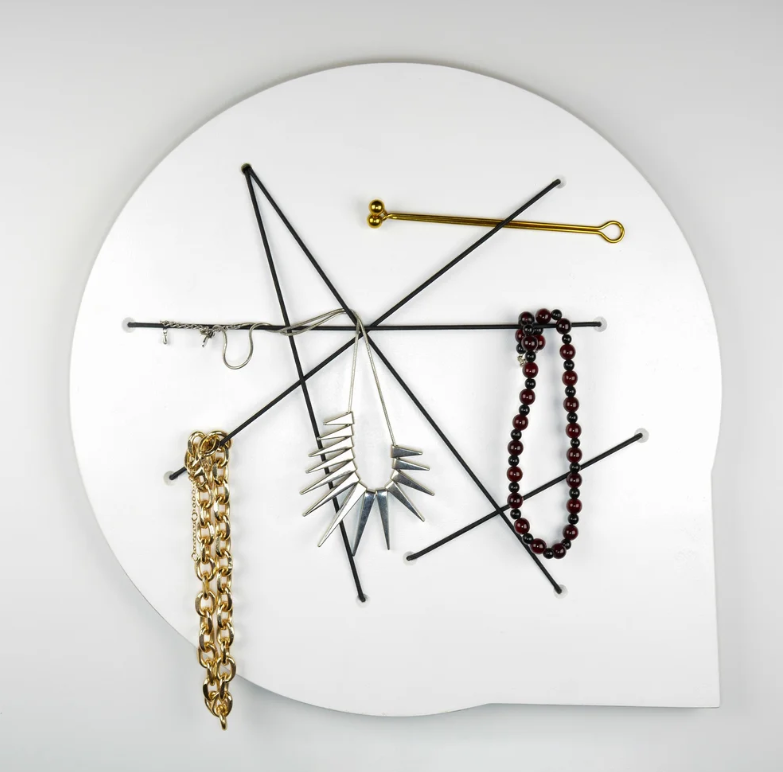
Word Bubbles: "A wall-mounted sculptural organizer equal parts memo board and conversation starter, it offers a temporary home for small objects, notes and mementos, turning everyday clutter into curated composition. Inspired by the comic-book speech bubble, a playful take on communication. Its clean silhouette embodies minimalist modernism, while an elastic cord invites tactile interaction—ready to capture thoughts, ideas, and objects."