As you stand at the counter of a Buffalo café and tell the volunteer your order, the line stretches behind you. A well-dressed businesswoman, on her way to and from meetings, converses with a single father who’s out running errands with his two boys in tow. Behind them, a millennial holding her college textbooks scans the menu and gives her recommendation to an immigrant couple who are new to Buffalo and unfamiliar with some of the food.
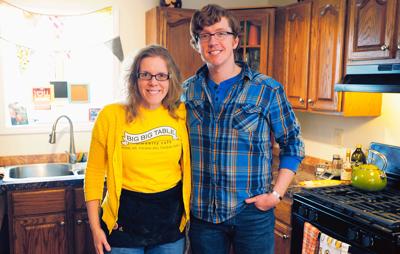
This is the type of scene Chef Mandy Bailey envisions when she describes Big Big Table, a nonprofit community café she’s planning where people from every background can come together to enjoy a healthy meal, regardless of their ability to pay for it. She and her husband, Trueman Muhrer-Irwin, have been working to make this vision a reality for four years and hope to finally open Big Big Table this year.
“A community café is all about being able to provide meals to everyone regardless of their means,” said Muhrer-Irwin. “Everybody has some way they can give, but that’s not always money. Basically, it’s a pay-what-you-can restaurant staffed by volunteers, people who earn their meals through their work.”
People are also reading…
At a community café, patrons can choose to pay the suggested price for a meal, add a little extra, or pay less or nothing at all, and instead volunteer their time. Bailey said community cafés usually receive 60-70 percent of the suggested prices overall and are staffed almost exclusively by volunteers.
Muhrer-Irwin said the cafés try to reach individuals who feel too uncomfortable or afraid of being judged to walk into a food pantry or similar organization.
“One of the best things about a community café is de-stigmatizing that need [for assistance,]” he said. “A lot of them really focus on making it so there is no difference between the customers who are paying for a meal and the customers who are working. Everybody goes through the line the same way, but just the way people give is different.”
The first community café opened in Salt Lake City in 2003; its goal was to provide meals to all and help address the chronic problem of food insecurity in the United States. According to the U.S. Department of Agriculture, during 2014, 14 percent of American households experienced food insecurity, defined as the uncertainty of having or being able to acquire enough food to meet every family member’s needs because of insufficient money or other resources.
Today, according to One World Everybody Eats (OWEE), there are 50 community cafés nationwide, with another 20 being planned.
Bailey first heard of the concept in 2011. At the time, she had been working as a chef for a local company and was discouraged by the wastefulness.
“Working for a big company, I discovered that, at the end of a shift, they were throwing away humungous portions of food and not doing anything else with it,” she said. “That’s not my jam. I wanted to do something with more heart.”
The couple has pursued the idea ever since, with early support from Lafayette Avenue Presbyterian Church and business training from the Westminster Economic Development Initiative. Bailey has twice traveled to Denver, Colorado, where three community cafés operate, to learn from other cafés and attend the annual OWEE Summit, a gathering for community café entrepreneurs to share ideas.
The couple has raised private donations and purchased most of the equipment they’ll need, and are now applying for grants. The only step left before they can open is to find a space — ideally, they said, in a neighborhood with a range of income levels, where they can make a difference by providing access to nutritious meals.
“[Buffalo] is the perfect place for something like this — it’s a food town, it’s a place with community, with both need and social consciousness,” Muhrer-Irwin said.
By tabling at the North Buffalo Farmers Market and events like the Taste of Diversity Festival, they’ve also developed strong relationships with local producers.
“Food security, sustainable practices and inclusive community — those are the three pillars we want to build around, and as part of those sustainable practices, we want to get food locally, buy in season,” Muhrer-Irwin said. “Rather than having a permanent, printed menu, what we serve from week to week will vary according to what’s on sale and what’s available.”
With an ever-changing menu, volunteers will also be able to suggest ideas, cook their own recipes and highlight their cultures.
“I want to focus in on the ethnic diversity of the West Side of the city, and I’m very excited about learning lots of different wonderful things from people,” Bailey said.
Muhrer-Irwin continued, “That’s a great thing about the volunteer side of the model. If you get active, regular volunteers who come from a different culture and have a different culinary experience, they can contribute their knowledge and experience to what goes on at Big Big Table.”
While they haven’t set a definitive timeline for opening, the couple has promised one thing: The Big Big Table will, in fact, have a big, big table for customers to gather around.
“Most community cafés actually have what they call a community table, where people sit together and actually make friends with each other and build the community,” Bailey said. “We’re doing this to bring people together.”