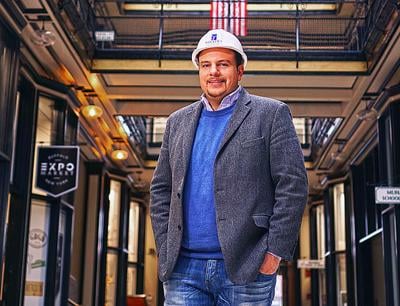
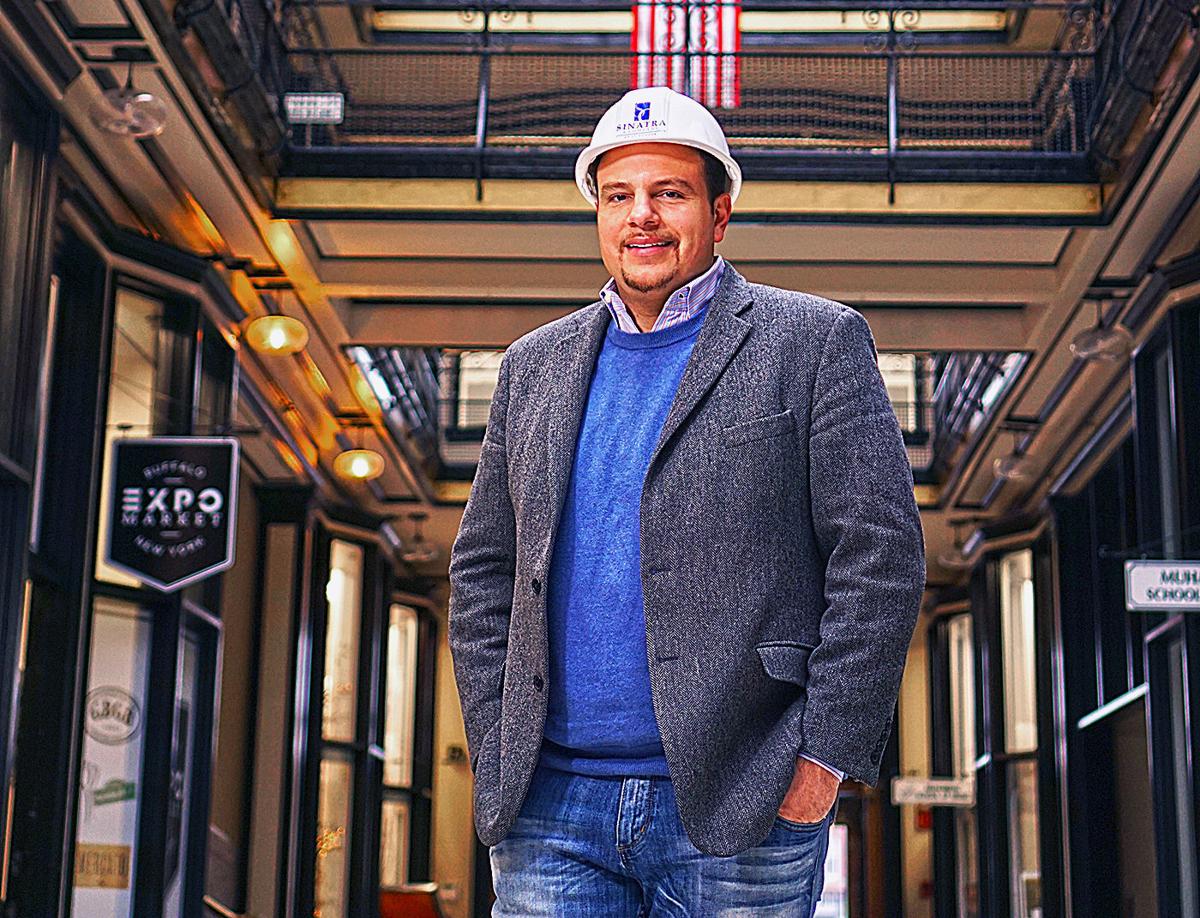
There is perhaps no better embodiment of Buffalo’s comeback right now than Nick Sinatra.
Not because of the buildings he’s renovating or the game-changing developments he’s championing — although of course they buoy the comeback. It’s more about his personal story, and what it symbolizes: how hard work, authenticity and tenacity pay off. And how — even after moving in some of our country’s most elite circles — Buffalo has the power to draw a person back in.
At age 35, his Sinatra & Co. portfolio is estimated at $175 million. It’s a long way from his childhood home on the West Side, where he lived until his parents divorced when he was 11. After that he lived with his mom and spent weekends with his dad — which often meant hours at Sinatra’s, the family restaurant on Kenmore Avenue.
“As soon as I was taller than the cutting board, I was put to work,” Sinatra said. Throughout his school years he worked there washing dishes, preparing food, working the front of the house — and learned every area of the restaurant.
People are also reading…
It was good training, he said, for the next phase of his life as an undergraduate at Yale. While his classmates interned at high-profile companies in New York and Boston, Sinatra spent summers back in the restaurant, which he describes as a pressure cooker. “Working in the restaurant prepared me better than any of those internships,” explained Sinatra. “Dealing with people who don’t show up for work, vendors who don’t deliver...a restaurant throws into focus the flaws of humanity.”
It also taught him the value of hard work.
“I was never the smartest person, but nobody was going to outwork me,” he said. “I’m a grinder.”
After graduating from Yale, he moved onto the ultimate pressure cooker: the White House, where he reported to Karl Rove, chief of staff for George W. Bush. He said the days working as an associate political director were long and stressful. “If Karl called me at 6:45 a.m. for an answer, I’d better be awake and ready.” He recalled getting a call from Rove on Air Force One, berating him about a memo with a misplaced comma.
While he said his time in Washington was invaluable for building experience and contacts, he decided to leave after three years. He had become disillusioned by the modern political climate.
“I saw how the sausage was made, and I didn’t want to eat the sausage anymore,” said Sinatra.
So he applied to the Wharton School of Business, graduated during the economic decline — prime time for investing in real estate — and consulted the Rolodex he developed during his White House days.
That led to securing a capital source from Connecticut-based investors, and Sinatra’s first development projects. Since then – 2009 – the company has grown. Quickly.
Today his interests include – among many others – the mixed-use Fenton Village at the corner of Main Street and West Ferry; Wayne & Waldorf and The Phoenix, both mixed-use renovation projects near the Medical Campus; the American Household Moving & Storage Building (1661 Main Street), being renovated into affordable “workforce housing” apartments; and the Market Arcade complex on Main Street, where the company moved its headquarters. He is also the force behind EXPO, the hip new food hall that opened last month downtown. (See story, page 12.)
All told, his holdings include 1,700 apartments and 1 million square feet of commercial space throughout Buffalo and beyond.
Many of his current efforts are concentrated around the Medical Campus, Elmwood Village and downtown. Sinatra & Co. recently threw its hat into the ring of proposals for the high-profile revamp of the Women and Children’s Hospital site on Bryant Street, which will become vacant this year.
He thinks there’s a relatively collaborative environment for local developers in Buffalo, that it’s not as cutthroat as he’s seen in other regions. He’s friendly with most of the other big developers – Paladino, Termini, Savarino – and he also thinks there’s a much-improved municipal environment in which to work in Buffalo. “City Hall is more streamlined,” he said. “The mayor is accessible.” He also sees more of what he terms “New Buffalo Thinking” – people understanding that when it comes to new opportunities, “the pie is not finite. The pie can get bigger.”
Giving back
In the world of real estate development, Sinatra is low-key, relatively humble — perhaps a “kinder, gentler” local developer. And his commitment to this community – for the sake of the community – is an integral part of his business. He supports many local causes, and recently pledged 10 percent of profits from his Phoenix Brewery project to Say Yes Buffalo, the program that provides full scholarships to graduating city high school students. He plans to structure another upcoming project similarly. He feels it’s one important component of curbing the cycle of poverty that plagues the city.
“I value education – it changed my life,” said Sinatra. “As we’re developing all these things in Buffalo, we can’t ignore the other side.”
He said his desire to give back was instilled by his mother and his high school alma mater, St. Joseph Collegiate Institute. He also feels he has a stake in the neighborhoods where his projects fall, and says that’s reinforced in the company culture.
“When we’re working on a project, we believe we are redeveloping the entire block, not just one building,” he said. “If there’s trash on the sidewalk, I’ll pick it up – and our employees had better, too.”
Work is his life, which he describes as a daily “symphony” – many different pieces simultaneously in motion. In addition to the projects under development in Buffalo, his company also manages real estate in California and Chicago.
Despite the hectic pace, he said, he could never work the high-profile corporate finance jobs where many of his fellow Wharton classmates landed. The art of the deal gets his blood pumping, as does his curiosity. He works six days a week, reserving Sundays for personal time. “They are sacred,” he said, and devoted to cooking, eating, skiing and following politics – “still a hobby and a passion.”
It’s a life made for someone who’s single, which he is. He does want to be married and have kids…someday. Right now, he knows he’d only be an absentee dad.
“I want a certain kind of family,” said Sinatra. “So I want to wait ‘til I have the time to give to a wife and kids.”
He does have a girlfriend, although he doesn’t give much away…besides that she’s “not a vegetarian,” and is willing to partake in his Sunday cooking.
But right now, the focus seems almost wholly on work. Things are moving fast, and there’s a lot to oversee. As an entrepreneur, he’s also learning how to be a better manager, he said. “The two don’t necessarily go hand-in-hand.”
But, he says, nobody’s perfect.
“I always say you learn from your mistakes,” said Sinatra. He recalls the time he travelled with President Bush, who was presenting an award to the Boys & Girls Club in Hartford, Ct. They flew in on Marine One…and Sinatra, who was in charge of transporting the award, left it on the helicopter. After his frantic realization and a strategic rearranging of the president’s schedule (plus some helpful state troopers) the award arrived in the nick of time — and, Sinatra said, probably saved his job.
Which is fortunate, because they went on to fly that same day to the Connecticut home of Henry Kissinger. There they got a tour and spent hours with the host himself. “We saw pictures of him and Khrushchev, him and Mao. Plus heard all his stories. I could have listened for hours.”
A heady experience for the boy from the West Side who’s only midway through his 30s. He says it’s this mix of life experiences that makes him comfortable in almost any situation.
“I can move in many worlds,” explained Sinatra. “From briefing the President to talking to a guy swinging a hammer – I connect with both.”
Nick’s “hot list”
Favorite local restaurant: Sinatra’s, of course, but if not Sinatra’s or EXPO (new food hall downtown) — then Tempo.
Favorite band: Red Hot Chili Peppers
Top three books: John Adams by Walter Isaacson; Gulliver’s Travels by Jonathan Swift; and The Case for Democracy: The Power of Freedom to Overcome Tyranny and Terror by Natan Sharansky
Favorite travel destination: Anywhere in Italy because of the food, the culture, our family heritage — and the beauty of it all. Sometimes, I think I can go back a dozen times before I go anywhere else.
Biggest pet peeve: Pettiness
Best life lesson learned so far: If you don’t make mistakes, you’re not trying hard enough
2016 Presidential hopeful: I will support the Republican nominee.