

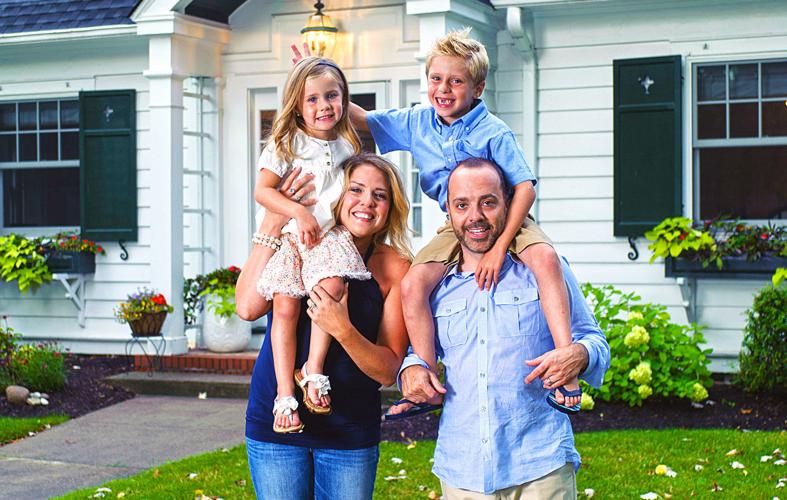



The kids now rule the family schedule (and more). What does that mean for now and the future?
In Erika Smerkar-Moore’s Amherst home, four o’clock is known as the “bewitching hour.” Relatives know not to call during that ultra-busy time, when she is rushing to get dinner out and her four children — Ava, 10; Gavin, 8; Finn, 7; and Ronan, 4 — are finishing up homework. Each child is being Suzuki-trained in an instrument, which requires three hours of practice a night, along with weekly private and group lessons on their instruments and an additional piano lesson on weekends.
‘The minute they get off the school bus, I have to start practicing with them to make sure we get everything done,” said Smerkar-Moore, who recently left her career as a physical therapist to manage the kids’ schedules.
She estimates that she spends two hours a night in her Chevy Suburban, going to and from music lessons and practices for swim team, basketball and track, depending on the season. Summers are more carefree, as the kids sleep late, spend time at the beach, play in the woods and learn to sail.
People are also reading…
“There are times when it’s very draining and exhausting, and if I’m sick, I still gotta do it,” she admits. “But it’s totally worth it.”
She beams when describing how Ava was accepted into the Greater Buffalo Youth String Orchestra for violin at just 10 years old, and said the benefits more than outweigh any drawbacks to their hectic lifestyle. “They are so talented and happy. If they ever came to me and said, ‘Mom, it’s too much,’ I would for sure cut something out. But they don’t — they love it.”
The Moores are the picture of many of today’s Western New York families: multiple kids; even more sports and activities; tons of running around — and families who are busier than at any point in modern history.
Bur in Snyder, Jenny Sinatra takes a different approach to family life, one that some might consider more old-fashioned. Nightly dinners are sacred, a time to gather together and talk about their days. Her children, 13-year-old Alex and 10-year-old Matthew, each play two sports, but Sinatra feels strongly that her children need downtime at home.
“Kids need the chance to use their imaginations,” said Sinatra, also a stay-at-home mother. “Having those moments when you’re bored and figure out a way to use your imagination to find something to do, whether it’s picking up a book or going in the yard and making a fort out of sticks — you don’t get to do those things when everything is scheduled for you.”
While their approach to parenting may seem at odds, both Smerkar-Moore and Sinatra report that their children are happy and well-adjusted. Like all parents, they profess a fierce, unwavering love for their children. And both are living in our new, child-centric world.
A generational change
Recent time-use studies present perhaps the clearest picture of our changing culture. A 2013 Pew Research study found that today’s parents spend more time with their children than ever before. Per week, fathers devoted nearly three times as many hours on childcare in 2011 than in 1965. Meanwhile, mothers spent an additional four hours a week with their kids in 2011 — despite juggling, on average, 13 more hours of paid work.
According to Christine Wang, associate professor and interim director of the Fisher-Price Early Childhood Research Center in the UB Graduate School of Education, parenting — and society more generally — has become more child-centered in response to a better understanding of childhood development.
“If you look at a historical painting of children, like in medieval times, the children don’t have distinct features — they are basically miniature adults,” she explained.
“They viewed children as pre-adults and didn’t see childhood as a distinct developmental stage. Children having unique developmental needs is a relatively modern concept.”
By the 1970s, parenthood began to change at a more accelerated pace. According to Jennifer Senior’s 2014 book All Joy and No Fun: The Paradox of Modern Parenthood, in the ’70s, the term “housewife” gave way to “stay-at-home mom,” and the word “parent” first gained popularity as a verb. “Parent” went from something you were, to something you did, all the time, above all other obligations.
And today, “good” parenting — a vague, impossible-to-define standard — seems to be at least partially measured by how much time we devote to our children and how protective we are of them.
In a recent essay in The Atlantic, Hanna Rosin marveled that parental behaviors that would have been considered paranoid in the 1970s — like accompanying kids down the playground slide — are now commonplace. One study she cited, conducted in urban, suburban and rural neighborhoods in the UK, showed that 80 percent of third graders walked to school alone in 1971. Within two decades, that figure had decreased to a scant 9 percent, and has continued to fall from there.
Where is the line?
Wang argues that child-centered parenting, at its core, is a great thing because it respects a child’s unique characteristics and attempts to meet their needs.
However, according to Jamie Ostrov, a developmental psychology expert at UB, this can often lead to overparenting, which results in reduced coping skills among kids, and high anxiety among parents.
“Overparenting is [defined as] developmentally inappropriate levels of parental intrusion, problem solving and engagement in the lives of their children,” Ostrov said. Not allowing kids enough freedom for self-development can also be problematic. “There is some evidence that children who are raised by overprotective parents may be at greater risk for narcissism and have ineffective coping strategies as young adults, which may promote anxiety and increased stress, as well.”
Kenneth Condrell, a child psychologist and family therapist in Clarence, said many factors, including increased pressure for kids to get into private and charter schools — not to mention good universities — is behind some of today’s new, more intense child-rearing. With increased competitiveness in every arena – especially sports — parents are reacting to the society we live in. One generation ago, kids could take up a sport (and be competitive) as late as high school. Today, that is rare; kids are playing on travel teams as early as the third grade.
Every parent wants to give their child a leg up, an early advantage. The problems arise when parents go to extremes, “helicoptering” their child’s every move and enrolling them in a laundry list of activities — whether they like it or not.
“Back in the ’50s, parents didn’t feel responsible for children’s fun. They didn’t necessarily organize things, and there weren’t leagues and activities like we have today,” Condrell said. “But over the years, parents have shifted to a position where the more you do for your children, the ‘better’ you are as a parent.”
Of course, enrichment activities — such as summer camp, Scouts, league sports, music lessons and more — offer important benefits. Among them, experts cite increased self-esteem from accomplishments, better social skills and improved motor skills and balance.
But experts believe that children also need time to play freely, and that too many scheduled activities can rob kids of that opportunity. Scott Eberle, vice president of play studies at the Strong Museum of Play in Rochester, recalled hearing parents of fourth graders interrogating the teacher: “What are you doing now to ensure my kid will get into a good college?” It’s these same parents who would send their children to computer camp and science camp and advanced art camp — one right after another all summer long — to get a leg up.
Eberle stressed that research shows children learn many important, unteachable skills from free play, and that the simple phrase “go outside and play” should be in every parent’s lexicon. “Play is the natural state of kids. It’s how they explore and learn. When children are four, they’ve learned how to play together, which, next to language, is one of the most important things we learn in our entire lives — how to relate to other people,” Eberle said. “It’s about problem-solving and negotiating in a social space. When you’re playing with a bunch of other kids, you’re sorting out where you belong, and that’s a skill that’s really impossible to teach.”
Eberle said parents should support kids’ play by setting up a jungle gym or taking them to the beach, but should also allow them room to explore free from parental guidance or instruction.
“Play that is recruited for specific adult purposes ends up being like chocolate-covered broccoli,” he said. “Other countries like Germany and Japan know the value of recess, and nobody’s been complaining that the Germans and the Japanese are falling behind academically. You have to give kids the opportunity to play.”
Achieving balance
As with most things, experts agree that it’s best to strive for a balanced approach: some scheduled activities, some free play. But the idea of “balance” differs from family to family and child to child — and can be elusive.
Jessica Moore — sister-in-law to Smerkar-Moore — is seeking that balance with her kids: William, 6, and Stella, 4. Both take Suzuki guitar (something musical), dance class (something physical) and swimming lessons (for safety reasons, since the family owns a boat). But she and her husband, Bill, juggle demanding careers as an architect and lawyer, respectively, and have said “no” to any additional activities.
“You have to teach your kids that they’re not necessarily the center of the universe, and you’re not going to drop everything and have everyone’s lives revolve around the fact that they have a game at 4 o’clock,” Jessica said. “There are a lot of times when I’m out of town for work, and my husband can’t be in two places at once. That’s reality.”
A 1966 research study by Diana Baumrind can help parents find their place on the parenting spectrum. Still often cited today, the study (expanded by Eleanor Maccoby and John A. Martin in 1983) proposed four general parenting styles: neglectful; permissive, which indulges a child’s whims but makes few demands; totalitarian, which demands much but is unresponsive to kids’ needs; and authoritative, a balanced style that tries to meet kids’ needs but also demands certain responsibilities. Permissive, totalitarian and authoritative parents are all child-centered to some degree — with decidedly different results.
“Permissive parents demand low responsibility from kids, so the kids tend to be quite selfish because their needs are always the highest priority for the parents and they’re never asked to give back,” Wang explained. “[Totalitarian] parents tend to ignore the kids’ emotional needs and say, ‘In the future they will be grateful for the decision I’m making.’ Those kids are usually quite resentful.”
Time for parents
Whether conscious of it or not, finding that sweet spot on the spectrum is what most of today’s parents strive for. That need for balance extends to kid-free time, too. Bill and Jessica Moore make it a point to carve out time for each other.
“We learned that from my mother- and father-in-law. They’ve been married for over 40 years, and my husband said that growing up, his parents made a weekly date night. They had five kids and life was crazy, but they always did that,” Jessica said. “Bill learned a lot from that, and I want my kids to see us spending quality time together and making that important.”
The reality is that many parents feel worse about disappointing their children than their partners — and therefore seek to spend even more time with the kids. Pew Research found that 33 percent of all parents and 46 percent of fathers in particular say they are not spending enough time with their children.
But experts say that solely focusing on the children over your marriage or your own well-being is detrimental to you and your partner — and your children.
“When you are divided, running through fast food and not having dinner or hanging out at home, there’s very little time to take care of the marriage,” Condrell said. “The best thing you can do for your children is nurture the love you have for their mom or dad. The more you strengthen your marriage, the better the home environment and the better the whole atmosphere is for your children.”
Sometimes, finding time for kids or spouses is easier said than done, however. Smerkar-Moore’s husband, Michael, has his own dental practice and often works 70 hours a week. To make up for that time away, the family skis together in the winter and spends summer weekends together at the beach.
“It’s difficult for him because he misses out on things,” said Smerkar-Moore, who admits that date nights for her and Michael are usually restricted to special occasions. “He’s a great dad, but he can’t be there all the time, so that is hard.”
Why so much change??
In All Joy and No Fun, Senior offers another possible explanation for our child-centered culture. In other societies and time periods, she writes, parents’ goals were clear: An English aristocrat had to train her son to be another aristocrat. A farmer in India or a Civil War-era blacksmith raised another farmer or blacksmith.
Today, Senior argues, the roadmap is less clear. Parents often cite abstract outcomes like happiness, success or strong moral values among their hopes and dreams for their children’s future, causing them to try many different avenues to achieve those aims. And in many ways, those efforts by parents are outstanding because children are exposed to more than they have been in previous generations, which opens up more possibilities for the future.
“Somebody once asked me, ‘Why are you doing the Suzuki [program]? Do you want them to be a Bach?’” said Smerkar-Moore. “I want to give them as many opportunities [as possible] so they can be creative, happy adults and do whatever they want.”
Experts do recommend that parents allow their kids to try new things, and even fail once in a while, in order to learn resilience, self-determination and the ability to overcome obstacles. It’s not necessarily how scheduled they are, but how they handle obstacles and/or challenges that can make a difference.
“When I went to college, there was one phone per floor in the dorms, so you called home once a week or once a month. Now, kids at college are calling back not just daily but several times a day, and parents are more involved in decisions that kids should be making themselves,” Eberle says. “You learn less when somebody tells you how to do something than when you discover it for yourself, which is also more morally edifying and character-building.”
And what do the kids think? Overall, they believe their parents are doing a great job. In 1999, Ellen Galinsky, president and cofounder of the Families and Work Institute, surveyed more than 1,000 kids aged 8 to 18 and asked them to grade their parents on a number of factors. Only 10 percent said their number one wish was to spend more time with their mothers, and just 15.5 percent wished for more time with dad.
However, a combined 61.5 percent wished that either mom or dad would be less stressed.
Jenny Sinatra subscribes to that philosophy. She doesn’t pressure herself to fill the kids’ days with activities or run themselves ragged. In fact, the occasional pajama day, when her boys can play outside and she can relax, is a welcome respite. But she doesn’t claim that her way is the only way.
“Everyone has to do what works best for them. This is what works for us and this is what makes me feel good about the job I’m doing as a parent,” said Sinatra. “We’re all just doing the best we can. You’re certainly not harming your children as long as you have the best intentions and always have your family and your children in mind.”