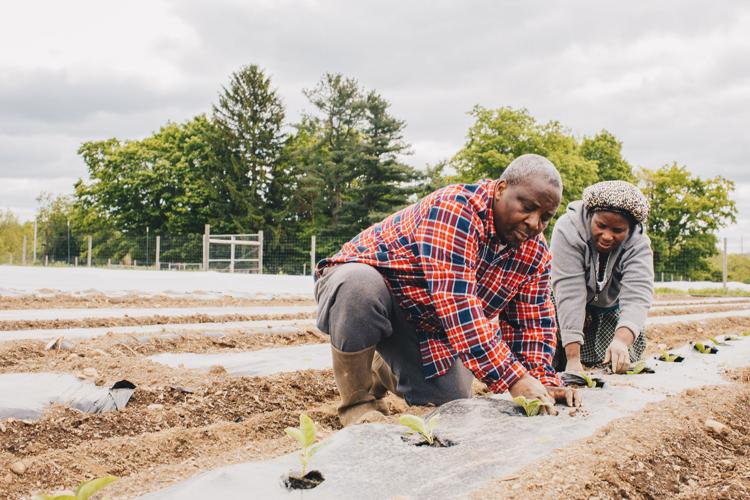
Within a patchwork of neatly tilled farm plots, women in brightly patterned skirts coax weeds from between pepper plants. Two men bend to inspect a tiller motor. Others move with efficient strides to carry trays of transplants from the greenhouse to the field, supplies from a box truck to the barn and themselves to their next task. Bits of multilingual conversations, peals of laughter and the rhythm of tools tapping soil hang in the warm morning air.
This land is bustling, alive.
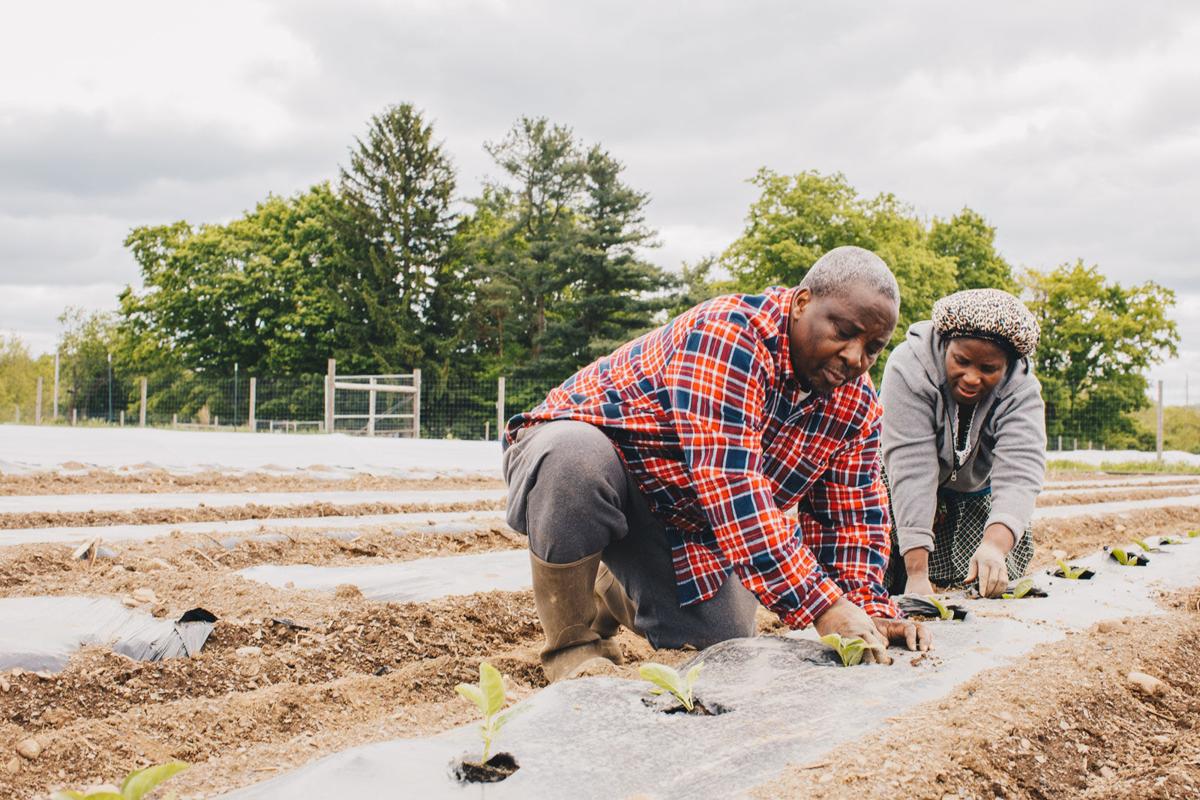
Out in one of the western fields, Ndanga Ramazani works his way down a mounded row. He uses two strokes of a hoe to break an opening every 18 inches in black plastic weed barrier, readying the row to welcome eggplant seedlings.
He doesn’t measure, but his practiced eye spaces them perfectly. These are skills he developed as a child in the Democratic Republic of Congo, working the soil alongside his parents to grow food for his family and neighbors.
People are also reading…
“I learned from my parents,” says Ndanga. “Their money came from farming, and when I came to the United States, I wanted to use those skills to grow healthy and delicious food."
Ndanga is a farmer at Providence Farm Collective (PFC), a 37-acre farm in Orchard Park that shares land and mentorship with new and seasoned farmers who couldn’t otherwise access farm properties of their own. In turn, the farmers grow produce to feed their families, sell for extra income and donate to local food banks.
Getting back to their roots

The farm began as the Somali Bantu Community Farm, a three-year pilot launched in 2017 to address the challenges in fresh food insecurity and farmland access for refugees resettled in Buffalo’s East and West Side food deserts and landless housing. It has since grown to include farmers from all over the globe and here in WNY. They work together and share resources, challenges and a bounty of nutritious produce.
The farm has two parts. There’s a collective of 200 volunteers who work in the community farm to grow food for their households and for Western New York feeding organizations. Last year, PFC donated nearly 14,000 pounds of produce to food pantries around the region.
The farm also runs an incubator program to support 30 independent farmers, who sell their produce at the farm’s store in Orchard Park, at its International Farmers Market on Grant Steet in Buffalo, through the farm’s community-supported agriculture shares and wholesale direct to restaurants and grocery stores. Crops include American standards, plus produce popular in other parts of the world that’s hard to find here, such as roselle (hibiscus used for tea), African maize, sweet potato leaves and more.
That, says PFC Executive Director Kristin Heltman-Weiss, is an essential ingredient in building strong, healthy communities.
“The people who shop at our markets say, ‘This tastes like it did back home’ because it was just harvested,” she explains. “They can afford it, they know who grew it, and they feel valued when farmers go through this effort to make sure these foods are available. Our farmers’ hearts are in rural lives. It’s a disservice we do by resettling refugees into our poorest neighborhoods where they can’t be as self-sufficient as they’ve been before or use the agricultural skills they have in meaningful, waged work.”
Skill building, in the field and out
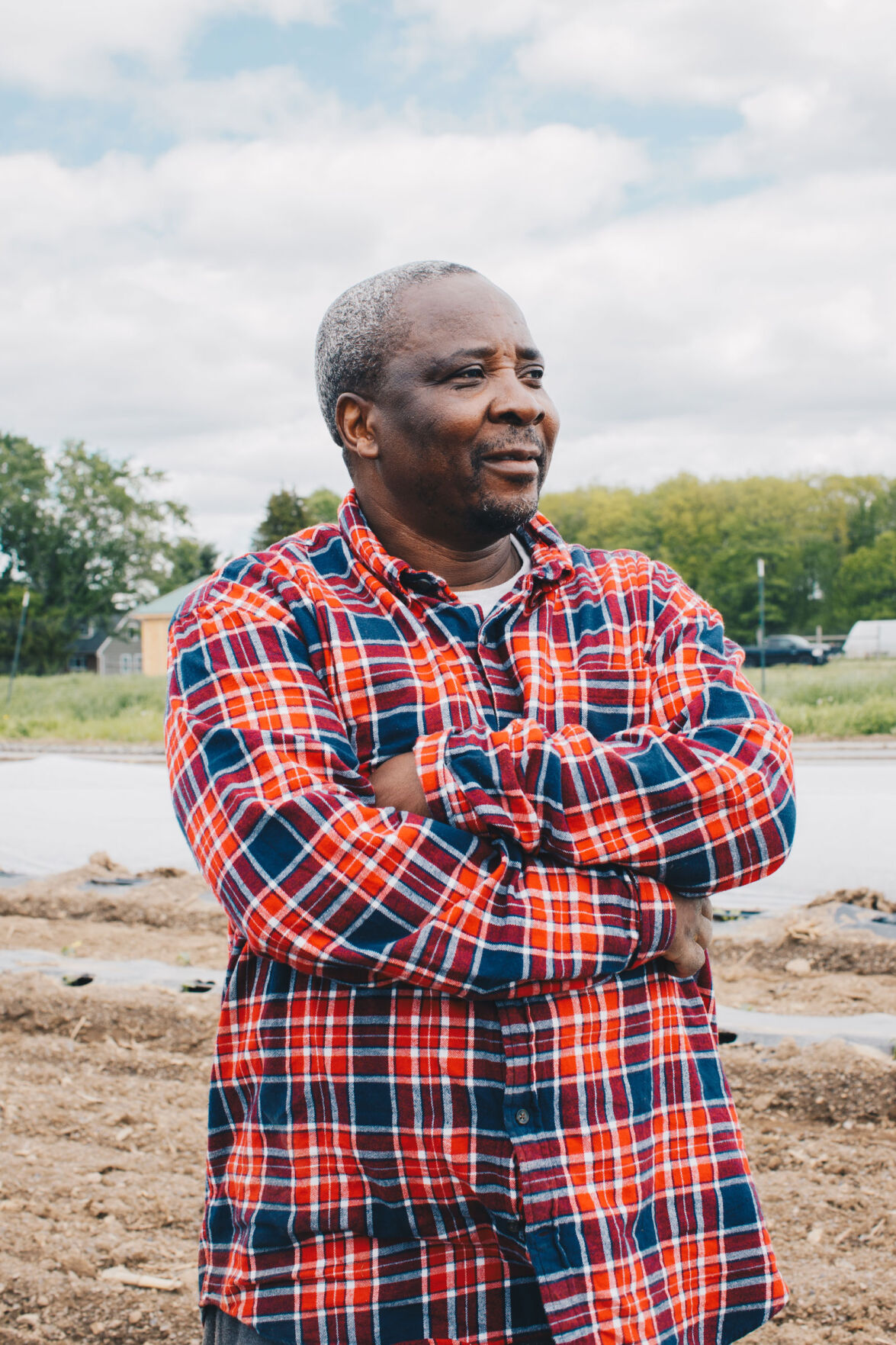
Ndanga Ramazani at his plot at Providence Farm Collective in Orchard Park.
Ndanga tends his quarter-acre plot four days a week with his wife, Feza Ekanga, growing greens and vegetables to sell at the Providence farm stand and direct to customers he connects with through social media. When school is out, a few of their eight children help. He joined Providence Farm Collective’s community farm in 2020 and graduated to his own farm this year. It’s called Abeka Farm in honor of his home village where he learned to farm, a custom many PFC farmers adopt. But he’s dreaming bigger.
In the next few years, Ndanga hopes to expand to two acres and add crops he knows his Congolese and American customers are looking for like amaranth, beans and corn. The extra produce will lead to more income, which he plans to invest back into the farm, use to pay for his kids’ education, donate to his church and save for retirement.
To prepare, he visits area farms with other Providence members to see how different growers operate. He also attends conferences and takes courses at the farm to help develop his farming and entrepreneurial skill sets.
“Our staff mentors each speak three or four languages and know each culture represented on our farm,” Kristin explains. “Teaching in native languages is important for discussing completely new concepts like frost warnings. They work alongside partners from places like Cornell Cooperative Extension, whose veggie experts can talk about organic pest management and issues unique to WNY. It’s one of the coolest things we have going on here.”
Ndanga is industrious off the farm, too. He is active in his church, which he founded and serves as pastor for. He also works in behavioral health and earned a bachelor’s degree from SUNY Buffalo State University in social work, a profession he sees as very similar to farming.
“Both social work and farming share a focus on meeting human needs and promoting wellbeing and empowerment,” he explains. “Both emphasize the importance of relationships, community engagement, advocacy and social justice.”
Threatened but resilient

Community engagement and advocacy have become critically important to the farm in recent months. In April, the farm received devastating news: The federal government revoked a $750,000 grant citing DEI (diversity, equity and inclusion) concerns, essential funds the farm planned to use to connect rural farm community resources to urban areas that lacked fresh food.
“It’s so short sighted,” Kristin says. “There are two million acres of farmland in transition in New York State, but not enough programs to train new farmers to get them onto this land to grow food. If the [United States Department of Agriculture] isn’t funding programs for farmers, which ultimately benefit consumers, what does that say about us as a country? The old farmers are going to retire and sell to developers and farmers markets will close in cities where people need fresh foods. In a region with agricultural roots and a city where people don’t have fresh food, we are providing a solution.”
But the fight wasn't over. In June, PFC, along with several co-plaintiffs, filed a motion for a preliminary injunction in federal court to restore terminated USDA grants and halt ongoing unlawful practices. On Aug. 14, the USDA was ordered by a D.C. District Court to reinstate the funding and that the original actions were likely unlawful and would cause irreparable harm to the affected organizations.
“This decision provides relief for the moment, as it restores essential grant funding while the lawsuit continues to work its way through the courts," Kristin said in a press release. "As the only incubator program in the region, we know PFC’s vital role in the Western New York food system and are working to mitigate the future harm that the USDA grant termination threatens to our regional community.”
In the meantime, the community can help support the farm by buying produce at PFC’s farmstand and West Side farmers market, volunteering on the farm, calling local representatives, and taking the time to learn about and invest in the local food system.
For now, Ndanga will continue to root himself in his work’s purpose—nourishing the health of his family, his farm and his community.
“Cultivating the land gives us strength,” he explains. “It can be long, hard work, but that’s how you succeed in life.”